A Buddhist sanctuary in the heart of the Zala forest
Above Zalaszántó, in the forests of Kovácsi Hill, an unexpected sight awaits visitors.
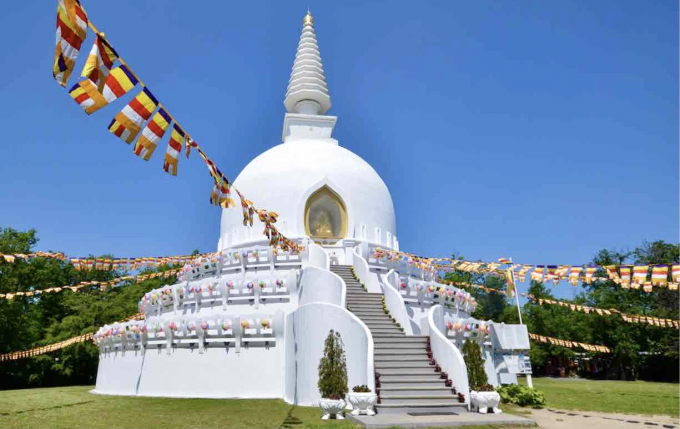
Suddenly, in the middle of a woodland clearing, an enormous snow-white Buddhist stupa appears.
Standing 30 metres high and 24 metres wide, the Peace Stupa has become one of the best-known symbols of Zalaszántó and a unique site of Buddhist culture in Hungary.
The sanctuary stands in the Human Rights Park, far from the noise of towns and surrounded by forest. Even the journey there helps you leave everyday life behind for a while.
How did a Buddhist stupa come to Zalaszántó?
The story began in the early 1990s.
Bop Jon, whose birth name was Jin Soo Lee, a South Korean Buddhist monk, wanted to create a sanctuary in Central Europe symbolising world peace, happiness and enlightenment.
After a long search, Zalaszántó was chosen as the right location.
A Buddhist ceremony preceded the selection of the site, after which construction began. Significant support came from South Korean and Austrian donors, while the structure itself was built by Hungarian professionals.
It contains a relic of the Buddha
The stupa is not simply an unusual piece of architecture; it is a genuine Buddhist sanctuary.
Inside is a relic believed to come from the earthly remains of the Buddha.
The relic travelled from the Potala Palace in Tibet to India, then to Europe and finally to the stupa at Zalaszántó.
For Buddhist visitors, the site therefore has important religious significance, although it is open to everyone who wishes to visit.
Consecrated by the Dalai Lama
One of the most important events in the history of the stupa took place on 17 June 1993.
On that day, the 14th Dalai Lama, Tenzin Gyatso, visited Zalaszántó and personally consecrated the sanctuary, which had been built as a symbol of world peace.
This connection makes the Zalaszántó Peace Stupa a particularly important site of Buddhism in Hungary.
What does a stupa represent?
The stupa is one of the ancient sacred structures of Buddhist culture.
The different elements of its form carry symbolic meanings, while the structure as a whole recalls the teachings of the Buddha, enlightenment and the search for inner peace.
According to Buddhist tradition, a stupa is usually walked around in a clockwise direction.
You do not, however, need to treat your visit as a religious ritual. Walk slowly, notice the details of the structure and simply enjoy the tranquillity of the surroundings.
Colourful prayer flags among the trees
Buddhist prayer flags surrounding the white stupa add even more character to the setting.
In Tibetan tradition, the five colours represent, among other things, the five elements, while prayers and mantras are printed on the flags.
As the wind moves them, it seems to carry these good wishes onwards – for peace, compassion and harmony.
The green forests of Zala, the brilliant white stupa and the colourful prayer flags create a truly distinctive scene.
A place where it feels good to be quiet for a while
The Peace Stupa is not somewhere to visit in a hurry.
This is not the kind of attraction where you take two photographs and immediately move on.
Sit down for a while. Listen to the forest. Walk slowly around the stupa. If the meditation house is open, it is worth stepping inside as well.
Regardless of your religion or beliefs, the setting can be a memorable experience if you enjoy peaceful places surrounded by nature.
The journey is part of the experience
The stupa can be approached by car from Zalaszántó, and from the designated parking area a woodland walk leads to the sanctuary.
This is exactly how we recommend experiencing it.
Don’t think only about the destination: the forests of Kovácsi Hill, the paths and the growing sense of quiet are all part of the experience.
Comfortable footwear is definitely recommended.
Combine it with a hike
The countryside around Zalaszántó is one of the most beautiful hiking areas in the region.
If you enjoy walking, you can combine a visit to the Peace Stupa with exploring Kovácsi Hill, or continue on a longer hike to other natural and historic attractions nearby.
Above Zalaszántó you will also find the ruins of Tátika Castle, while the ancient beech forest of Tátika, one of the special natural treasures of the Balaton Uplands National Park, lies nearby.
The stupa can therefore become one stop on a full-day “Zalaszántó and its three hills” excursion.
Different in every season
In spring, fresh green woodland surrounds the stupa. In summer, shady forest paths lead the way, while autumn brings a canopy filled with colour.
And in winter, when snow covers Kovácsi Hill, the white sanctuary and silent forest take on an entirely different atmosphere.
That is why we recommend the Peace Stupa as much more than a summer attraction.
Bon Villa tip: Don’t simply drive as close as possible to the stupa. Turn your visit into a short woodland walk and allow yourself time to circle the sanctuary and enjoy the silence. If you still have time and energy afterwards, continue your day towards the ruins of Tátika Castle. For an especially peaceful experience, visit in the morning or late afternoon, when there tend to be fewer people around.
A Buddhist sanctuary in the forests of Zala, a relic of the Buddha, colourful prayer flags and deep tranquillity – the Zalaszántó Peace Stupa is the kind of place you may remember long after your visit is over.