Where the story of higher agricultural education in Hungary began
György Festetics founded the Georgikon in Keszthely in 1797, Europe’s first independent institution of higher agricultural education.
The aim was never limited to classroom theory. On the training farm established alongside the school, students could learn and apply modern agricultural methods in practice.
The Georgikon farm operated as an independent training estate until 1848. New crop varieties, machinery, farming methods and technologies were tested here, and the results were carefully documented.
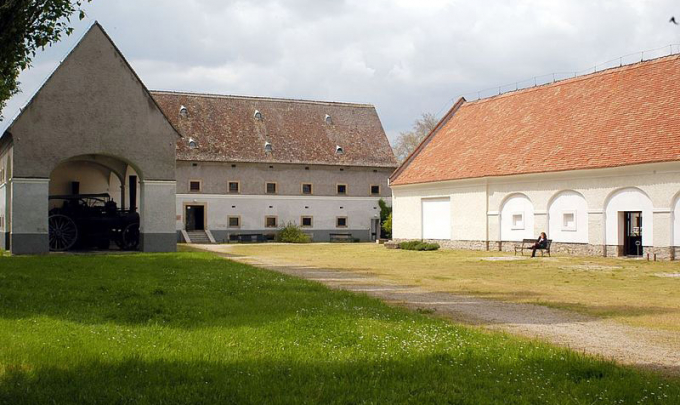
Today, the buildings of the former training farm are home to the Georgikon Farm Museum of the Hungarian Museum and Library of Agriculture.
Not your typical agricultural museum
One of the greatest attractions of the Georgikon is that the historic setting itself is part of the story.
Inside the former farm buildings, a series of exhibitions explores the development of agriculture, the operation of the Festetics estates and the lives of the people who once worked here.
In the four-storey Baroque granary, you can learn more about the viticulture and winemaking traditions of the Balaton Uplands, the history of agricultural education, the lives of 19th-century estate workers, and the processing and storage of grain.
The former stables contain exhibitions on crop production and animal husbandry, together with historic agricultural tools and machinery.
The Georgikon Agricultural School, 1797–1848
One of the museum’s newest permanent exhibitions opened in 2025 and tells the story of the Georgikon itself.
It explores how György Festetics’s remarkable school operated, who taught and studied here, the importance placed on practical training, and how Keszthely became one of Hungary’s most important centres of agricultural knowledge.
If you have already discovered the aristocratic lifestyle of the family at Festetics Palace, here you can explore a completely different side of their story: the knowledge, farming expertise and innovative thinking behind the operation of the vast Festetics estates.
Huge machines and genuine rarities
The Georgikon is home to several historic agricultural machines that are worth seeing in their own right.
One of the highlights is the Fowler steam ploughing system, in which two enormous steam engines were used to pull a plough back and forth across a field.
Another rarity in the collection is a working heavy-oil tractor manufactured in 1924.
During selected special events, some of the museum’s historic machinery is even demonstrated in operation.
The Experience Farm – where you can do more than just look
Behind the museum lies the 1.2-hectare Experience Farm, where the atmosphere of the old estate becomes much more tangible.
You can walk through orchards, vineyards, herb and medicinal gardens, vegetable plots and field crops while discovering how closely crop production and animal husbandry were once connected.
Meet the farm animals
The Experience Farm is also home to farm animals, making it an especially enjoyable place to visit with children.
The farmyard, stables and animal enclosures help younger visitors understand how a traditional estate farm once worked.
Traditional games and play areas add even more variety, allowing a museum visit to turn naturally into some outdoor family fun.
Try the games children played in the past
At the Georgikon, children can discover that people managed to have plenty of fun long before smartphones and games consoles existed.
Traditional wooden games and the play barn recreate something of the world of village children in earlier times.
And don’t be surprised if the adults end up reluctant to hand the stilts or one of the old-fashioned skill games back to the children.
The farm really comes alive during special events
Throughout the year, the Georgikon hosts a variety of heritage, family and traditional craft events.
It is particularly worth looking out for occasions when historic agricultural machinery is demonstrated in operation or traditional farming activities are brought back to life.
Always check the current events programme before setting off.
A great destination by bicycle too
The Georgikon is easily accessible from the centre of Keszthely and Festetics Palace.
It is also a good destination by bicycle, with connections from the Balaton cycling route, the Keszthely–Hévíz cycle path and the direction of Kis-Balaton. Covered bicycle parking is available at the entrance.
Visitors arriving by car can also park on the museum grounds.
How much time should you allow?
If you are mainly interested in the exhibitions, you can explore the farm complex in a few hours.
With children, however, it is better not to plan too tight a schedule. The Experience Farm, animals, gardens and games can easily tempt you to stay much longer.
Bon Villa tip: Don’t necessarily try to squeeze Festetics Palace and the Georgikon into the same morning. If you are visiting with children, allow at least half a day for the Georgikon. Start by exploring the historic farm buildings and machinery, then head outside to the Experience Farm for the animals, gardens and traditional games. And if you are following the wider Festetics legacy, this is one of the best places after the palace to understand how a vast aristocratic estate actually worked and supported itself.
Historic machinery, animals, gardens and more than two hundred years of agricultural history – at the Georgikon, you can discover a completely different and much more hands-on side of the Festetics legacy.